How to Follow Up on an Estimate Without Being Annoying (Day 1, Day 3, Day 7)
Three copy-paste follow-up texts for the estimate that went quiet: one on Day 1, one on Day 3, one on Day 7. Then you stop.
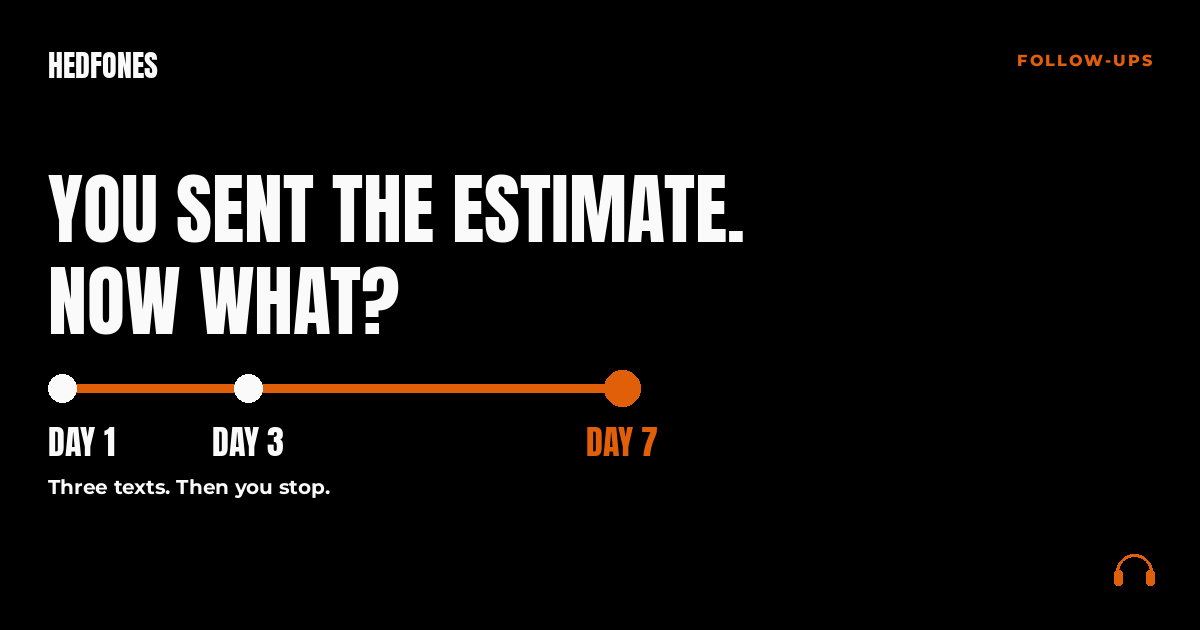
Give It a Job
The estimate went out Tuesday
EXAMPLE SCENARIO. A fictional HVAC company walks a homeowner through a furnace replacement on Monday afternoon. Good visit. Good questions. The owner writes it up that night and sends the estimate Tuesday morning. Then Tuesday ends. Then Wednesday. By Friday the owner has started three more jobs, and the estimate is an email nobody has thought about since.
Two weeks later, another company's truck is in that driveway.
Maybe the price lost it. Maybe it didn't. Nobody found out, because nobody asked. The homeowner was busy too. They meant to reply. The company that checked in got the job.
Following up feels pushy, so most people either skip it, or send one text at a random moment and then feel awkward about sending another. The fix is a schedule you decide before the estimate goes out. Three texts, on three set days. Then you stop.
Below is the follow-up from the Missed Call Toolkit, word for word. Copy it, swap the words in braces for yours, and use it on the next estimate you send. It works without us.
The script: Day 1, Day 3, Day 7
Count from the day the estimate goes out. Put all three dates on your calendar the moment you hit send, or they won't happen.
Day 1: The check-in
Send it the day after the estimate goes out.
Hi {First name}, it's {Company}. Did you get a chance to look at the estimate for {job}?
This one is just logistics. Estimates land in spam. They get opened on a phone in a parking lot and forgotten. You're not asking for a decision. You're making sure they have it.
Day 3: The question
Still holding this one for {job}. Any questions I can answer?
"Any questions" makes room for the real reason they haven't said yes. The price. The timing. A spouse who hasn't seen it. A line item that didn't make sense. A question is easy to answer. A decision isn't. Give them the easy one.
Day 7: Close the loop
I'll close this out unless you want to keep it open. Just reply and I'll reach out.
This is the text that tends to get an answer. It's polite, it's final, and it puts the next move in their hands. Some people reply "Still want it, sorry, crazy week." Some reply "We went another way." Both are answers.
Why "then you stop" matters
A clean no beats a ghosted maybe. A maybe sits on your list. You think about it at red lights. You hold a slot for it. You wonder whether a fourth text would be the one. By then it reads like chasing.
Stopping after Day 7 does three things:
- It frees the slot. The time you were saving for them goes to a job that's actually happening.
- It keeps the door open. You ended polite. If they come back in the spring, you're the company that didn't nag.
- It's a habit you can keep. Three texts per estimate is a system. "Until they answer" isn't.
The rules from the missed-call texts carry over. Say your company name. One question per text. These go to someone who asked you for an estimate, so they're customer care. Keep them off any promo list. If they reply STOP, you stop. That includes Day 7.
When they reply
The script is for silence. Once they answer, you're in a conversation, and the script is done.
- "Yes." Book it today. Offer two real windows: "Great. I can start {Mon} or {Wed}. Which works?"
- A question. Answer it. If it takes more than two texts, call.
- "It's more than we expected." Call. Don't send a discount by text. Ask which part of the job matters most and whether there's a version that fits. Sometimes there is.
- "We need to think about it." "Of course. Want me to check back in a couple of weeks?" Then do exactly what they said.
- "We went with someone else." "Thanks for letting us know. Good luck with the project." Nothing else. That's how you stay on the list for next time.
What not to send
Just following up again!! Did you see my last 3 messages?
Guilt. It turns their silence into your complaint.
Prices go up Friday, so you'll want to lock this in today.
Fake urgency. If it isn't true, don't say it. If it is true, say it once, on a call.
I can take 10% off if you sign this week.
A discount nobody asked for. You just negotiated against yourself, by text.
Hey!
No company name, no job, no question. They have to scroll up to figure out who you are.
Leave the price out of the follow-ups, too. It's already in the estimate. Repeating it in a text makes it the headline.
Where the manual way breaks
The texts work. The calendar is the part that slips.
Three texts per estimate is easy with two estimates out. With twelve out, it's thirty-six reminders, each on its own day, each with the right name and the right job. Day 3 lands on the morning a crew member calls in sick. Day 7 lands on a Saturday. One customer gets two Day 1 texts and another gets none.
The replies don't wait for a break, either. A "yes" that sits in your pocket until tonight is a "yes" that has all afternoon to change its mind.
The same job, given to an agent
EXAMPLE SCENARIO. Northfield Heating & Air, a made-up company. The owner sends the estimate Tuesday morning and marks it as sent. A Hedfones agent has the follow-up in writing: send Day 1, Day 3 and Day 7 on schedule, in the owner's words, and stop the moment the customer answers. Any yes, no or question goes straight back to the owner.
Wednesday (Day 1)
Agent: Hi Dana, it's Northfield Heating & Air. Did you get a chance to look at the estimate for the furnace replacement?
Friday (Day 3)
Agent: Still holding this one for the furnace replacement. Any questions I can answer?
Customer: Yes. Does that price include hauling away the old unit?
Agent: Good question. I'm passing it to Sam so you get the right answer.
Sam, the owner, gets a ping with Dana's question and the whole thread. The Day 7 text never goes out, because Dana answered. The agent didn't guess at the haul-away answer, either. A guess would be a promise. Northfield Heating & Air is fictional. The thread is an example of the job.
It's the same kind of agent that texts back missed calls in under a minute. Different job, same idea: one job, written down, with a stop line.
What the agent will not do
The job description has a stop line. These stay out of the thread, from you or from the agent:
- A discount or a new price. Price talk goes back to you.
- An answer it can't back up. Scope, warranty, "does that include…" all go back to you.
- A fourth text. Day 7 is the last one.
- Another follow-up after a reply. A yes, a no or a question ends the script and comes to you.
- Pressure. No deadlines that aren't real. No "just checking again!!"
- Pretending you typed it. If an agent sent the text, it doesn't sign it like you wrote it from the truck.
If they reply STOP, the agent stops. No last word after that.
The three texts work by hand. When you want the quote chase handled without a calendar full of reminders, tell us what it is.