What to Text a Customer After a Missed Call: 7 Templates for Contractors
Seven copy-paste texts to send a customer after a missed call, including the one question that sorts an estimate from everything else.
Give It a Job
The call at 12:14, the callback at 3:47
EXAMPLE SCENARIO. A fictional roofer is halfway through a tear-off. The phone rings at 12:14 p.m. It's in the truck. There might be a voicemail. There might be nothing. The next free hand is hours later. At 3:47 p.m. the callback goes out, and the person on the other end has already found someone.
Same lead. Different afternoon. The estimate never got a chance to be too high or too low. The first answer was silence, and silence is when people dial the next name on the list.
The phone doesn't care that you're on a roof. It doesn't care that you're under a sink or in an attic, either. The job is the same for any small shop whose hands are full: what to text a customer after a missed call, before they move on.
Below are seven missed-call text-back templates for contractors. Copy them, swap the words in braces for yours, and send them today. They work without us.
Text 1: The opener
Send this within a minute or two of the missed call. Send it before you try to call them back.
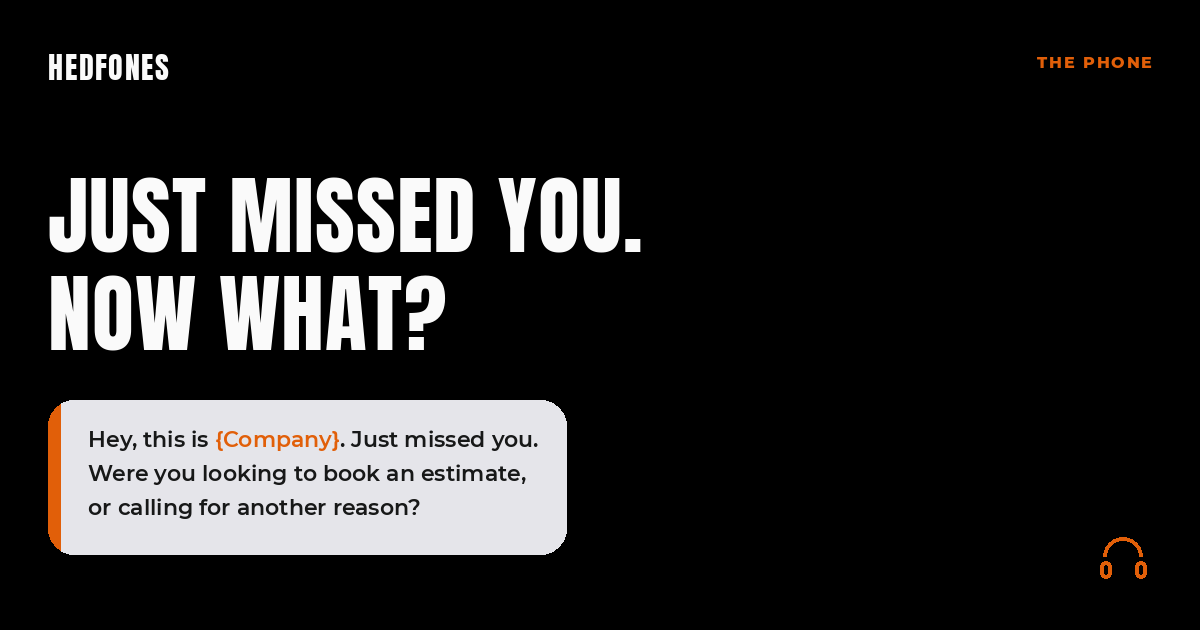
Hey, this is {Company}. Just missed you. Were you looking to book an estimate, or calling for another reason?
One question sorts the call. They say estimate, and you start intake. They say anything else, and you know it can wait until you're off the ladder.
Three things are doing the work:
- It's fast. They hear from you before they dial the next name.
- It's human. No "valued customer." No menu. A person missed a call.
- It forks the conversation in one question. Estimate starts intake. Anything else can wait.
A few rules for every text in this post. Say your company name every time. One question per text, not a form. If it scrolls, it's too long. These answer someone who called you. Customer care only. Leave them off any promo list. If they reply STOP, you stop. Full stop.
Save the opener on your phone before the next job, so you're not rewriting it with wet gloves. iPhone: Settings → General → Keyboard → Text Replacement. Android (Gboard): Gboard settings → Dictionary → Personal dictionary.
Six more missed-call texts
Text 1 is for the number you don't recognize. These six cover the reply, the clock, and the caller you already know.
Text 2: They want an estimate
They answered the opener. Take the job one question at a time, and skip anything they already told you.
In: Estimate. Water coming in around the chimney.
Out: Got it. What's the address, or at least the ZIP?
Out: Thanks. Can you send a photo or two? Helps us show up ready.
The address tells you whether you cover the area. Ask for the photo once. If it doesn't come, move on.
Text 3: After hours
Calls after you've clocked out.
Hey, this is {Company}. Just missed you. We're done for the day, but we'll pick this up first thing {tomorrow}. Quick head start: estimate, or something else?
Promise a time you'll actually keep. First thing means first thing.
Text 4: Emergency
No heat, a burst pipe, water through the ceiling.
In: pipe burst in the basement water everywhere
Out: On it. If anyone's in danger or you smell gas, get out and call 911 first. I'm getting {Owner} on this right now.
Don't offer estimate windows. Don't name an arrival time you can't back up. Stop texting and call them as soon as you can. A useful extra, when it's water: "Do you know where your main water shutoff is?"
Text 5: Existing customer
The number is already in your contacts.
Hey {First name}, it's {Company}. Just missed you. Is this about the {job} at {street}, or something new?
Their name plus their job says you remember them. That's the whole trick.
Text 6: Out of area
Send this once you have a town or ZIP, after the opener has already told them who you are.
I'm not sure we cover {town/ZIP}. Let me check and get right back to you.
Don't book the visit until you've decided you'll drive there.
Text 7: "Who is this?"
It happens. People call a few contractors in one afternoon. Don't take it personally.
This is {Company}. I just missed your call. Were you looking for an estimate, or something else?
Same fork, once they know who you are.
What not to send
Sorry I missed you!!
No question. No next step. They still have to decide whether to try you again.
Sorry we missed your call! Please call back during business hours.
That's a door, closing. You just asked a lead to do your callback for you.
Leave links out. Leave the price out, including a guess. A ballpark in a text becomes the number they remember, and you haven't seen the job. Give them one clear thing to reply.
When you do get a minute, sort before you dial. Emergency first, then a new estimate, then an existing customer, then everything else. If they texted, keep texting. If they called, call. End with a booked window or a clear next step.
Where the manual way breaks
The texts work. Being the person who sends them is the part that slips.
You still have to see the missed call. You still need the shortcut, a free hand, and enough attention to tell a burst pipe from an ordinary estimate. You can't reach that shortcut while the phone is in the truck and you're two stories up. "First thing tomorrow" holds only if tomorrow starts with that person. The emergency text already says the rest: stop texting and call.
On a quiet Tuesday you can run all seven by hand. On a day with two jobs and a supplier waiting, the call at 12:14 is the one that turns into the callback at 3:47.
The same job, given to an agent
EXAMPLE SCENARIO. Summit Ridge Roofing, a made-up company. The owner is on the roof. A Hedfones agent has the job in writing: send the opener, take the details one question at a time, offer two windows the owner already approved, book the one they pick, and ping the owner. It texts back in under a minute. The owner stays on the roof.
Missed call, 12:14 p.m.
Agent: Hey, this is Summit Ridge Roofing. Just missed you. Were you looking to book an estimate, or calling for another reason?
Customer: Estimate. Water coming in around the chimney.
Agent: Got it. What's the address, or at least the ZIP?
Customer: 18 Cedar Lane.
Agent: Thanks. Can you send a photo or two? Helps us show up ready.
Customer: (sends a photo of the chimney)
Agent: We can do Thu 8–10 AM or Fri 1–3 PM. Which works?
Customer: Thursday morning.
Agent: You're set for Thu 8–10 AM. Alex will see you then. Reply here if you need to move it.
The first agent text is Text 1, with the company name filled in. The address, the photo, and the two windows are the same kit, one question at a time. The last line is the booked text. Summit Ridge Roofing is fictional. The thread is an example of the job.
What the agent will not do
The job description has a stop line. These stay out of the thread, from you or from the agent:
- A price, or a ballpark. Quote after you've seen the job.
- A discount nobody asked for.
- A time you haven't approved. It offers your windows and sticks to them.
- A diagnosis from a photo. "Probably just the flashing" is a promise you didn't mean to make.
- A guarantee. "We'll definitely have it done today."
- Pretending you typed it. If an agent sent the text, it doesn't sign the text like you wrote it from the truck.
Anything outside the job comes back to you. An emergency is a handoff: call them, and skip the Thursday-or-Friday offer. An address you might not cover waits until you decide you'll drive there. If they reply STOP, the agent stops. No last word after that.
The seven texts work by hand. When you want that job handled without the phone in your pocket, tell us what it is.